Blog
Context Engineering vs Prompt Engineering for AI Agents
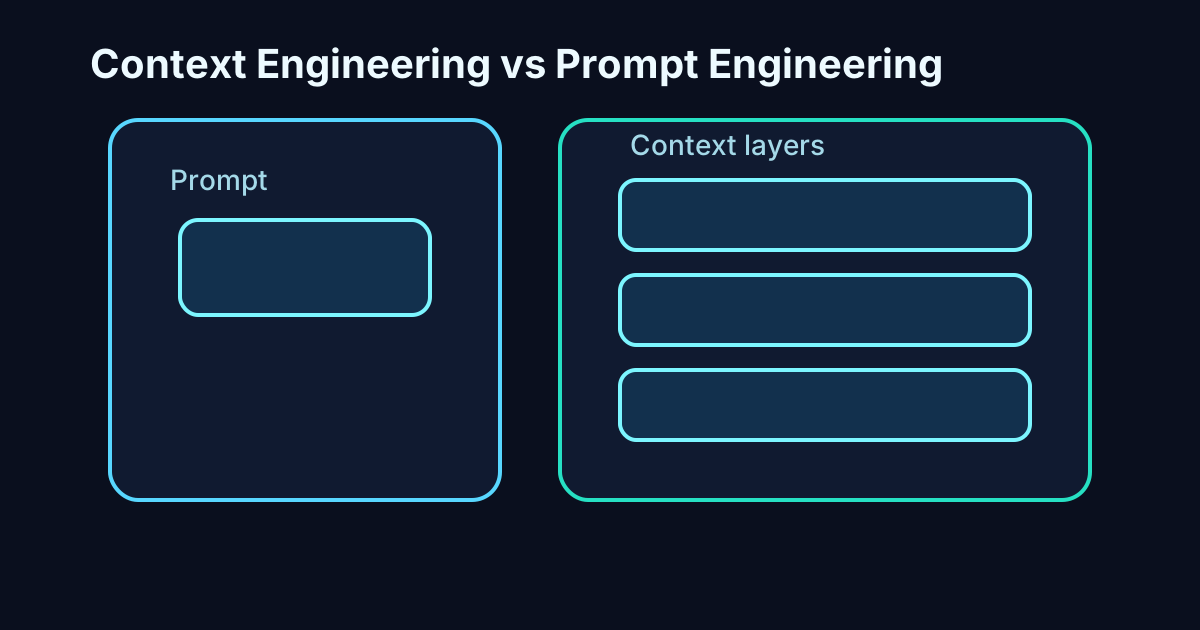
If you want the short answer, context engineering vs prompt engineering is really a question of scope.
Prompt engineering is about how you ask for one result. Context engineering is about how you shape the information, rules, memory, and working environment that make good results more likely across a whole session or workflow.
That is why context engineering matters more as soon as you move from one-off prompts to real AI agents.
A strong prompt can improve one answer. Strong context can improve every answer that comes after it.
This guide explains the difference, where each one matters, and how teams using agents should think about both.
What is prompt engineering?
Prompt engineering is the practice of structuring a request so the model produces a better response.
That can include:
- clear task instructions
- examples of good output
- output formatting requirements
- constraints and guardrails
- role framing
Prompt engineering is useful because models respond differently depending on how work is framed.
What is context engineering?
Context engineering is the practice of shaping the broader working environment around the model.
That includes things like:
- what instructions are always present
- what files the agent can read
- what memory or prior decisions it can access
- what session state is carried forward
- what tools and skills are available
- what rules define success or failure
If prompt engineering is the wording of the request, context engineering is the operating setup that surrounds the request.
Why the difference matters for agents
In a simple chat, a prompt may be enough.
In an agent system, the quality of the outcome depends on much more than the last message. The agent may need workspace rules, recent session history, memory, tool access, and the right routing behavior.
That is where context engineering starts to matter more than prompt phrasing alone.
OpenClaw is a good example of this distinction because the docs describe sessions, workspace files, skills, and multi-agent routing as core parts of how work is organized. The system is not just waiting for a single prompt. It is operating inside a structured environment.
Prompt engineering still matters
None of this means prompts stopped mattering.
They still matter when you need to:
- ask for a specific format
- tighten an output style
- provide examples
- limit scope
- request step-by-step reasoning or a checklist
A vague prompt in a strong context can still produce a vague answer.
Context engineering is what keeps quality steady
A good prompt can help once. Good context helps repeatedly.
That is what teams usually want in production.
For example, if an agent always has access to the right workspace files, clear operating rules, and stable session history, it can produce better work without being re-taught from scratch every turn.
That is a context problem, not just a prompt problem.
A practical example
Imagine you want an agent to prepare a daily executive brief.
A prompt-only approach might say: summarize today’s updates and list the next actions.
A context-engineered approach would also define:
- which sources count as valid inputs
- how recent context is retrieved
- what tone the brief should use
- what should be excluded
- where the final summary gets stored or sent
- when a human should review it
The second approach is much more reliable because the operating environment is clearer.
How OpenClaw maps to context engineering
Several OpenClaw concepts fit naturally into context engineering.
Sessions
The session docs explain that OpenClaw routes conversations into sessions and reuses them until reset rules expire. That matters because continuity changes what the agent can reasonably know from turn to turn.
Workspace files
Files like AGENTS.md, SOUL.md, and USER.md shape how the assistant behaves in a persistent way. That is not a prompt trick. It is context design.
Skills and tools
The skills docs explain that skills are loaded from different locations with precedence rules and can also be allowlisted per agent. That means what the agent can do is part of context too.
Multi-agent routing
In multi-agent setups, each agent gets its own workspace, state directory, and session store. That isolation is another form of context engineering because it keeps one agent’s working environment from leaking into another’s.
When prompt engineering is enough
Prompt engineering is often enough when the task is one-shot, low-risk, and self-contained.
For example:
- rewrite this paragraph
- summarize this article
- extract action items from this note
- turn this list into a table
Those tasks do not need much persistent structure.
When context engineering becomes necessary
Context engineering becomes necessary when the agent needs continuity, memory, role clarity, operating rules, or tool behavior that stays stable across many interactions.
That includes work like:
- recurring reports
- channel-based assistants
- multi-step workflows
- agents that need memory
- specialist agents with different roles
- systems that route work between agents
A good design rule
Use prompt engineering to improve the request.
Use context engineering to improve the system the request lands inside.
If a team keeps rewriting giant prompts to compensate for weak memory, unclear rules, or bad routing, they probably have a context problem.
Internal links worth reading next
- Memory guide
- Workspace files guide
- Skills guide
- What is OpenClaw
- OpenClaw memory best practices
- How to write AGENTS.md for OpenClaw
Official references:
Final take
The best agents need both prompt engineering and context engineering. But once you move into real workflows, context usually becomes the bigger lever because it shapes every turn, not just the current one.
FAQ
What is the difference between context engineering and prompt engineering?
Prompt engineering improves the wording of the request. Context engineering improves the surrounding information, memory, rules, and working setup.
Which matters more for AI agents?
For agents, context engineering usually matters more because agents work across sessions, tools, and repeated tasks.
Does prompt engineering still matter?
Yes. It still helps with clarity, structure, style, and output control.
What is an example of context engineering?
Giving an agent the right workspace files, memory access, tools, and routing rules is a form of context engineering.
Why does OpenClaw fit this topic?
OpenClaw exposes sessions, skills, workspace files, and multi-agent isolation, which makes context design a practical part of using the system.
Why teams keep over-optimizing prompts
Prompt changes are visible and easy to test, so teams reach for them first.
That makes sense. Rewriting a prompt is faster than redesigning memory, files, routing, or tool access.
But that convenience can hide the real issue. If the assistant keeps failing because it lacks stable context, better prompt wording will only help a little.
A useful mental model
Think of prompts as local instructions and context as system conditions.
Local instructions shape the current move. System conditions shape whether the agent can keep making good moves over time.
That is why prompt wins can feel impressive in demos while context wins feel more important in production.
What changes when you improve context first
When context is stronger, teams usually notice that prompts become shorter, outputs become steadier, and the assistant needs fewer repeated reminders.
That is a practical sign the system is maturing.
One trap to avoid
Do not use context engineering as an excuse to bury the agent in documentation. Better context is curated context. The job is to improve relevance, not to maximize volume.
How this changes content and workflow design
Once a team understands the difference, it usually stops treating every quality issue like a copywriting problem. Sometimes the fix is better examples in the prompt. Sometimes the fix is cleaner workspace rules, better retrieval, or better session boundaries.
That shift saves time because it points effort at the real bottleneck.
Another practical example
If an agent keeps producing inconsistent weekly reports, the problem may not be the report prompt. It may be that the assistant lacks a stable report template, cannot reliably find the right source inputs, or is mixing old and new context together.
Those are context failures, even if the symptom shows up in the final draft.
What to optimize first
If the task is one-shot, optimize the prompt first.
If the task is repeated, tool-using, multi-step, or cross-session, optimize the context first.
That is a simple rule, but it prevents a lot of wasted effort.
For most agent teams, that distinction is worth understanding early.
Related posts
View allContext Engineering vs Prompt Engineering: What Actually Matters for Agents
April 9, 2026
A practical look at context engineering vs prompt engineering, including the real difference and why agents need more than clever prompts.
Context Engineering for AI Agents: How to Give Agents Better Working Context
April 9, 2026
Learn what context engineering for AI agents really means, why it matters, and how to give agents the right working context for better output.
Context Engineering for AI Agents: How to Give Better Working Context
April 9, 2026
Learn what context engineering for AI agents means, why it matters more than longer prompts, and how to structure useful working context in OpenClaw.