Blog
Why Multi-Agent LLM Systems Fail and How to Fix Them
The most common reasons multi-agent LLM systems break down, how OpenClaw's architecture mitigates them, and practical patterns to make your setup more reliable.
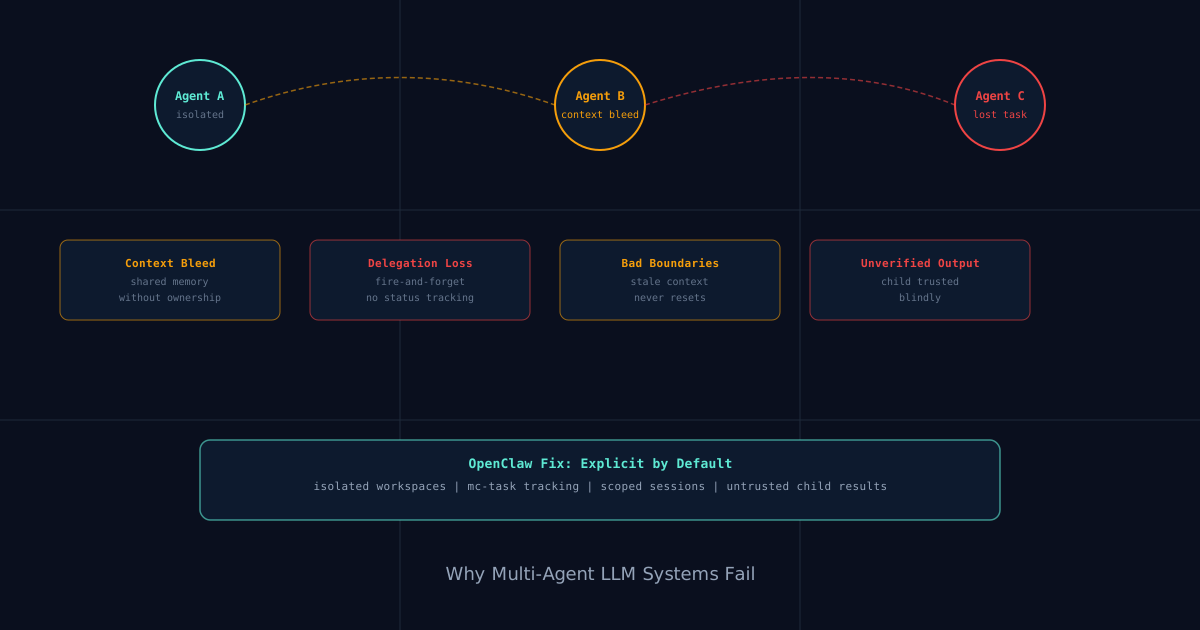
Most multi-agent LLM systems fail the same way: not in a single dramatic crash, but slowly, through accumulated coordination problems that nobody noticed until something important broke.
The short answer to why multi-agent systems fail is usually one of five things: agents bleed context from other agents, the orchestrator loses track of what was delegated, session boundaries are unclear, outputs from child agents get trusted too much, or the system has no recovery path when something goes wrong.
This guide walks through each failure mode, why it happens in practice, and how to design against it, with specific patterns from how OpenClaw handles these problems internally.
If you want the orchestration foundations first, read what AI agent orchestration is and the practical OpenClaw multi-agent guide. This piece goes one level deeper into what breaks and why.
Why this matters more than it used to
A year ago, most agent deployments were single-agent setups. One agent, one task, one context window. When something went wrong, the failure was contained and obvious.
Multi-agent setups are harder. You have multiple agents running in parallel or sequence, each with their own session, tools, and context. Coordination errors are not always visible. A child agent may complete successfully and return output that looks fine, but that output may be based on wrong assumptions it got from the parent, or it may have made decisions that contradict what another agent is doing in parallel.
That is the core problem. Multi-agent systems can fail at the coordination layer even when every individual agent is working correctly.
Failure mode 1: Context bleed
Context bleed happens when information from one agent's session leaks into another agent's session in a way that was not intended.
The common causes:
- Shared memory files that all agents read and write without clear ownership rules
- A parent agent that embeds too much of its own session state into the task prompt it sends to a child
- An agent that uses a shared config or workspace file where another agent is writing output
The result is an agent that starts making decisions based on context it was never supposed to have.
How to design against it:
OCPlatform's workspace model keeps agents isolated by default. Each agent has its own workspace, its own agentDir, and its own session store. The docs are clear that you should not reuse agentDir across agents.
In practice, that means:
- Keep shared memory scoped to files that are explicitly designated as shared input
- Use a designated output path for each agent rather than letting agents write to the same working files
- Pass context to child agents explicitly through task prompts, not through shared environment state
The rule is simple: if you would not want Agent B reading Agent A's personal notes, keep them separate.
Failure mode 2: Delegation loss
Delegation loss happens when the orchestrator spawns work but loses track of whether it was completed, what the output was, or what state it left things in.
This is the most common failure mode in systems that use fire-and-forget task delegation without proper status tracking.
Signs:
- An orchestrator moves on to the next step before confirming the previous one finished
- A task that "should have worked" silently failed, and nothing noticed
- The orchestrator sends the same task twice because it did not realize the first one was in progress
How to design against it:
Use task tracking consistently. OpenClaw's mission control system tracks task state explicitly. The pattern is:
mc-task create "Task title" "Description" agent-id in_progress
# do the work
mc-task done TASK_ID
For sub-agent delegation, create_task returns a session key you can monitor. If you use timeoutSeconds: 0 (fire-and-forget), you need a different mechanism to confirm completion, like a shared status file or a callback.
The general rule: if a task must complete before the next step can start, do not fire and forget it.
Failure mode 3: Unclear session boundaries
Session boundaries define what an agent knows and when its context resets. When these are unclear, agents make decisions based on stale information or carry over context that should have been dropped.
Common problems:
- An agent running as a sub-agent that inherits too much session context from the parent
- A long-running agent that never resets, accumulating outdated context over days or weeks
- A cron-triggered agent that sees last session's memory as if it were current
How to design against it:
OpenClaw sessions reset daily at 4 AM local time by default. For sub-agents, sessions are scoped to the task run and do not carry forward state from the parent's full session history.
The design principle from the OpenClaw docs is relevant: sub-agents are isolated from the parent except through explicitly passed context. That isolation is a feature, not a bug.
For agents that need continuity across sessions, use structured memory files (MEMORY.md, memory/YYYY-MM-DD.md) rather than relying on raw session context. Memory files are explicit, reviewable, and can be versioned.
Failure mode 4: Unverified child output
Multi-agent systems often treat the output of a child agent as authoritative without verification. This is fine when the child's job is clearly scoped and the output format is well-defined. It becomes a problem when:
- The child produced an output that looked correct but contained an error
- The child made an assumption that contradicts something the parent knows
- The child's output included instructions or content that get interpreted as commands by the parent
That last one is the injection problem. If a child agent's output gets inserted into the parent's context without sanitization, an adversarial input could influence the parent's behavior.
How to design against it:
Treat child outputs as data, not as commands. OpenClaw wraps untrusted sub-agent results in explicit boundaries (marked as UNTRUSTED_CHILD_RESULT) exactly to prevent this kind of bleed.
For your own multi-agent setups:
- Define clear output schemas for child agents and validate against them
- Do not pass child outputs directly into prompt text that the parent agent then acts on without review
- For high-stakes tasks, have the orchestrator verify key claims in child output before proceeding
The verification step does not need to be elaborate. Often a simple "does this output meet the expected shape?" check is enough to catch the most common failures.
Failure mode 5: No recovery path
Multi-agent systems with no recovery path treat every failure as catastrophic. When something goes wrong, everything stops or the system enters a broken state with no path forward.
This is especially common in pipeline architectures where Step 3 depends on Step 2, which depends on Step 1. If Step 2 fails halfway through, there is no mechanism to resume or rewind.
How to design against it:
Build explicit failure modes into your agent configs. OpenClaw's AGENTS.md conventions support stop conditions: situations where the agent should stop and escalate rather than proceed.
## Stop Conditions
- If the build fails three times with the same error, stop and message the DevOps group
- If the input data does not match the expected schema, stop and request clarification
- Do not proceed to deployment if any test suite has a failure
For orchestrators, that means:
- Check task status before advancing to the next step
- Define what "good enough" output looks like before treating a result as success
- Have an escalation path that actually reaches a human for tasks that matter
The pattern that works is: optimistic by default, explicit about failure, with a recovery step defined for every critical path.
The architecture that prevents most of these failures
Looking at the five failure modes together, a pattern emerges. Most of them come from the same root problem: implicit coupling.
Context bleed is implicit information sharing. Delegation loss is implicit status tracking. Unclear boundaries are implicit session lifecycle. Unverified output is implicit trust. No recovery path is implicit success assumption.
The antidote is explicit design. Every piece of shared context should be explicit. Every task delegation should have an explicit completion check. Every session boundary should be explicitly configured. Every child output should be treated explicitly as untrusted data. Every critical path should have an explicit failure case.
OpenClaw's architecture leans this way by default. Agents are isolated. Sessions are scoped. Sub-agent outputs are marked untrusted. Task tracking is built in. The workspace model keeps agent state separate.
But architecture alone does not prevent failures. You still need to write workspace files that enforce the isolation, define stop conditions for your agents, and design your orchestration flows around explicit dependencies.
Practical patterns that actually help
Pattern 1: One task, one output file. Each sub-agent writes its output to a single designated file. The orchestrator reads from that file rather than parsing raw chat output.
Pattern 2: Explicit readiness checks. Before starting a parallel delegation wave, verify that dependencies are in place. Before accepting output, check that it matches the expected shape.
Pattern 3: Short sub-agent scopes. Give sub-agents narrow, well-defined tasks rather than broad mandates. The smaller the scope, the more predictable the output.
Pattern 4: Staged trust. Treat all child outputs as draft until reviewed. For automated pipelines, "review" can be a schema check. For high-stakes decisions, it should involve a human.
Pattern 5: Idempotent tasks where possible. Design tasks so that running them twice does not cause harm. This makes recovery from delegation loss much cheaper.
FAQ
Why do multi-agent systems seem to work in testing but break in production?
Testing usually involves clean inputs and controlled timing. Production adds real-world edge cases, concurrent agent states, and accumulated session context. Most multi-agent failures are timing and state management problems, which are hard to reproduce in controlled tests.
Is it better to use fewer agents or more?
Fewer agents with well-defined scopes tend to be more reliable than many agents with fuzzy ones. The coordination overhead of multi-agent systems is real. Add agents when the task genuinely requires parallel execution or distinct expertise, not because it feels more "advanced."
How do OCPlatform sub-agents handle output validation?
OpenClaw wraps sub-agent results and marks them as untrusted third-party content. This is a structural reminder to treat them as data, not instructions. For schema validation of the actual content, that is the orchestrator's job.
What is the right escalation path when a multi-agent task fails?
Define it before you need it. Typically: agent logs the failure, writes a status update to its task, and messages a designated channel or person. OpenClaw supports Telegram, Discord, and other channels for exactly this kind of alert. The key is defining the escalation path in AGENTS.md or the orchestrator's operating rules before the system runs.
Does multi-agent coordination get harder at scale?
Yes, linearly. Every additional agent adds coordination surface area. The failure modes described here get more likely, not less, as more agents interact. Good workspace design, explicit task tracking, and well-scoped sub-agent roles become more important, not less important, as the system grows.
Are there failure modes unique to LLMs that do not apply to traditional multi-agent systems?
Yes. LLM agents can produce plausible-sounding wrong outputs. Traditional multi-agent systems usually fail with clear error codes. LLM outputs can appear correct while being subtly wrong, which makes verification harder. The "unverified child output" failure mode is much more insidious with LLMs than with deterministic agents.
For more on building reliable multi-agent setups with OpenClaw, read the multi-agent orchestration practical guide, AI agent guardrails best practices, and AI agent failure recovery patterns.